Designathon participants
40+
No additional detail

Accelerating policy document summarisation with human-centred AI, saving 60%+ time in testing
Accelerating policy document summarisation with human-centred AI, saving 60%+ time in testing
As Design Lead in Capgemini Invent's Innovation Lab, a consulting services environment, I led work on how to design AI-native tools and how to bring those tools into design practice.
No additional detail
Faster cycles
Agentic AI article
This case study focuses on AURA. Change management consultants needed a faster, more engaging way to communicate complex HR policies. AURA sought to do just that.
Rani helps organisations handle change. She often turns long HR and policy documents into engaging formats, like emails, intranet posts, and posters. She needs a way of speeding this up without losing accuracy.
Rani is sent lengthy workplace policy documents from clients. They can be hundreds of pages long, packed with complex language and legal terms.
She reads through each document in detail, manually highlighting and copying relevant sections into a separate working file for later rewriting.
Rani rewrites the extracted content in plain language, adjusting tone, structure, and length to match the intended audience, often rechecking for compliance.
She proofreads, formats, and finalises the summaries before sharing them with colleagues or clients. The whole process can take several days per document.
"These policies are too long for busy employees to digest."
"I need summaries that are both accurate and engaging."
"I wish tailoring content for different audiences were effortless."
"It's finally done. That took longer than it needed to."
The AURA prototype was developed through iterative experimentation and validation. We began with model selection, testing Claude Sonnet against alternative LLMs using parameters such as context length, summarisation accuracy, tone control, and processing speed, then chose a model that held up for lengthy HR and policy documents.
The architecture diagram shows how AURA connects to MongoDB, routes prompts through model services, handles auth, and logs activity for audit and safety. We primed the model with sample documents and applied a carefully crafted system prompt to maintain accuracy, avoid hallucinations, and tailor outputs to channels such as emails, posts, and posters.
I explored two interface concepts: a chat-style interface for conversational refinement and an agentic design with a document viewing pane for side-by-side reading, annotation, and summary generation. Rapid Figma prototypes and AI API integrations allowed us to test both paradigms quickly and make evidence-based design decisions.
Shows prompt presets, draft output, and lightweight edits with guardrails. Designed to keep users in control while speeding up first-draft creation.
Prioritised clarity and control: tighter labels, better empty states, simplified layouts, and consistent patterns across generate, review, and publish steps.
Sessions surfaced pain points around trust and explainability. We added clearer consent, source attribution, and reversible actions to build confidence.
We built a focused MVP that proves value without UI complexity. We selected Claude Sonnet for its long context window and reliable summarisation, primed it with representative HR and policy documents, and used a targeted system prompt to control tone and format.
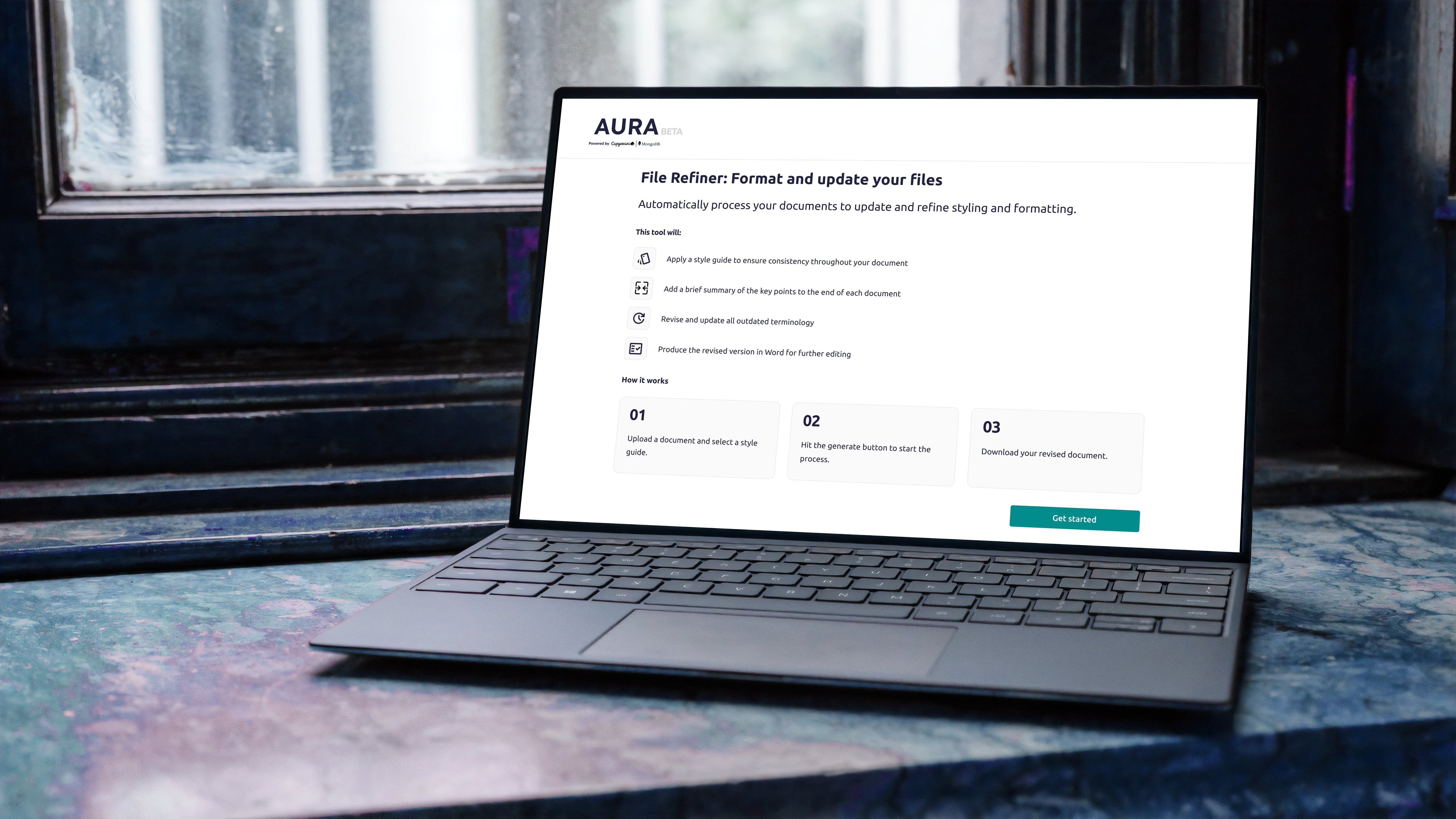
The document viewing pane and chat interface were removed from scope due to technical complexity and time. Summarisation ran behind the scenes, and users simply downloaded channel-ready outputs such as one-pagers, intranet posts, or poster copy. Fine-tuning or in-app editing was not included in the MVP.
This validated the core outcome fast: accurate, consistent summaries that reduced manual effort and improved clarity, ready for future iterations that can add a viewer, highlights, and conversational refinement.
The AURA proof of concept explored how RAG-powered AI could automatically summarise lengthy documents for public and private sector users. Through research, prototyping, and stakeholder testing, we validated the core value: AI could deliver accurate summaries behind the scenes, removing the need for a complex in-app viewer or editing tools at MVP stage.
While the project was paused before launch due to shifting priorities, it delivered clear learning on technical feasibility, user expectations, and MVP scoping. These insights have since informed other AI initiatives and strengthened our approach to designing responsible, human-centred AI tools.
Before narrowing scope
Estimate from testing
Automated behind-the-scenes summarisation
From concept to proof-of-concept, AURA showed how Retrieval-Augmented Generation could transform dense HR and policy documents into concise, engaging formats.
While the MVP was simplified and never shipped, the process produced internal learning, reusable design patterns, and a clearer view of the technical and ethical considerations for deploying AI in a consulting client context.
AURA began with a broad exploration of LLMs and embeddings, testing both open-source and proprietary models for accuracy, speed, and cost. We learned that model selection must be driven not just by technical benchmarks, but by the complexity of the documents, the domain language, and the required factual precision. This is equally relevant in a manufacturing or 'Design & Make' context, where the assistant may need to interpret lengthy technical manuals, engineering specs, or safety standards without losing nuance.
Unlike conventional products where content is static, AI outputs are probabilistic. This meant designing for uncertainty — with clear loading states, confidence indicators, and mechanisms for users to refine queries. In AURA, this took the form of persistent query history, expandable answer sections, and inline citations. These patterns are directly applicable to manufacturing-focused tools like Autodesk Assistant, where iterative questioning and quick validation of source material are essential.
In designing AURA, we found that AI is most valuable when it accelerates human decision-making, not replaces it. For summarising complex policy or technical documentation, we built in transparency features like source linking, full-document context views, and export options so users could verify outputs. The same principle applies in manufacturing workflows — whether checking compliance data or interpreting CAD-related standards, the human-in-the-loop remains essential for quality and accountability.